

This page contains my Synthesis work, from my first and final drafts as well as my Translation. I wrote about the dangers of the standardization of the Bengali language and how its history is rooted in colonialism. My first draft is definitely a lot more unpolished with less use of connections between each of the sources I used, while my final draft brings more connections and has a strong conclusion that adequately wraps up my point.
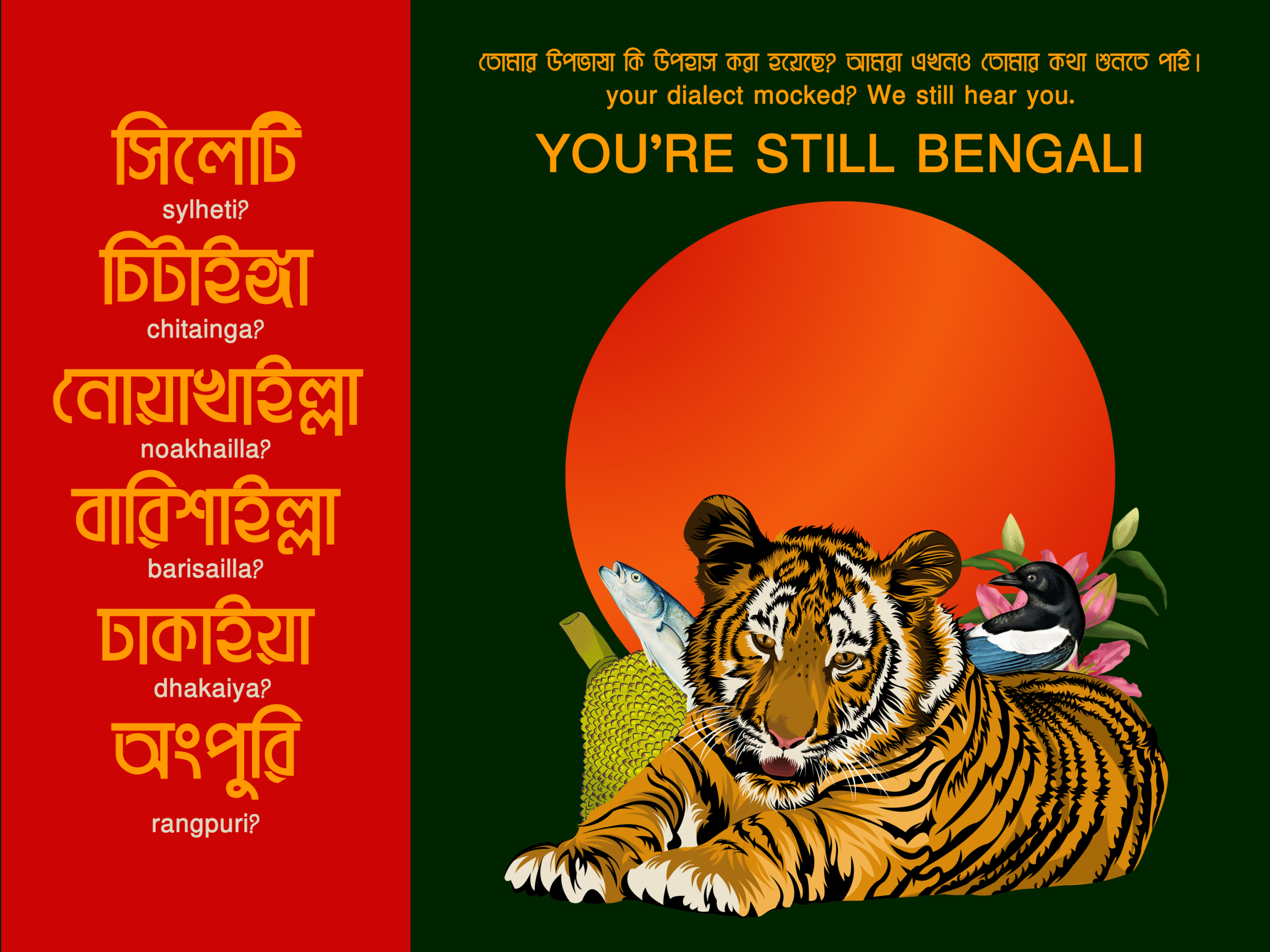
My Translation of my Synthesis: “YOU’RE STILL BENGALI”
My first full draft:
The Problem of a ‘Pure’ Bengali Language
Dialects are an integral part of language, carrying the history, culture, and identity of people who speak them. Despite their longstanding history and deep cultural roots, many non-standard are often dismissed as “inferior” and “impure”. This is especially relevant in the region of Bengal (comprising of the country of Bangladesh and the Indian states of West Bengal, Tripura, and part of Assam), where Standardized Bangla takes dominance over many regional dialects such as Sylheti and Chittagongian, leading to a class-hierarchy in terms of language, seeing the Standardized Bangla as part of the top while these regional dialects go towards the bottom.
Sheikh Mehedi Hasan and Adilur Rahaman, two Bangladeshi professors/researchers of language, in their research article “Standard Dialect Ideology in Bangladesh: A Field Study,” suggests that this placement of the standardized Bangla on a pedestal is part of a wider phenomenon called “Standard Dialect Ideology.” Hasan and Rahaman supports their claim by presenting evidence from their field study of how the Bengalis they interviewed stigmatized the use of non-standard dialects of Bangla. In one example, Hasan and Rahaman write that one of their participants (with the pseudonym “Tripti”) discussed with them about shielding her son from non-standard dialects of Bangla by enrolling him in an English-Medium school, despite having the ability to speak with a Barisali dialect herself. Tripti views that her son having the ability to speak in Standard Bangla will give others the impression of being part of the “upper class people,” which won’t be the case if he were exposed to a variety of non-standard dialects (116-117). While people like Tripti believe that learning to only take in Standard Bangla is a means of survival and acceptance in a community, many historians believe that setting such boundaries for language is unhealthy. Abdul Awal, a PhD student in Linguistics, in his scholarly article “Linguistics Purism in Bengali Language in Bangladesh: Myth and Reality”, argues that trying to maintain the “purification” of a language will only cause the death of it. Awal illustrates this when he writes, “The Latin language was claimed to be ‘True Language’; the reason why Latin has become a dead language is that it has not been developed and transformed into the vernacular language (colloquial language/common people language)” (70). In the same essence, Bangla would face the risk of dying out if people do not allow for the use of “common people language,” in this case, the local dialects.
Critics might argue that Awal’s claim that Bangla faces a risk of dying is far from true because Bangla is one of the most spoken languages in the world. And in some ways, they are correct. According to the CIA World Factbook, Bangla is the 7th most spoken language in the world, with 3.4% of the world’s population speaking the language, roughly estimated to be about 270 million people (CIA World Factbook). However, this view is incredibly narrow, as the statistic focuses solely on the number of speakers, irrespective of the dialects, rather than the cultural and linguistic diversity associated with Bangla. While Bangla may continue to thrive statistically, the gradual disappearance and neglect of regional dialects can lead to the eventual downfall of its authenticity.
Now, in the case of Bangla, where does their language purism stem from? Monsur Musa, a professor of Language and Linguistics, implies that calls for a “pure” Bangla derive from both religious superiority and colonialism, pushing for a more “correct” Bangla. Musa supports his implication by narrating different stories about the evolution and division of the Bengali language through a political and religious lens. To give a bit of context, the majority of Bengali speakers in Bangladesh (East Bengal) adhere to Islam, while a majority of Bengali Speakers in India (focused around the Indian states of West Bengal, Tripura, and the Barak Valley of Assam) adhere to Hinduism. In the case of religious superiority, Musa discusses the area of Nodiya (currently “Nadia” in West Bengal), in which their Bangla dialect is considered to be the purest version of the language. Musa discusses that Nodiya was one of the strongholds of the Sanskrit language (a classical language that is the stem of multiple Indo-Aryan languages and the language used in many sacred Hindu texts) during the time of Muslim rule in Bengal. Chaitannya Dev, a widely influential Hindu religious leader based in Nodiya, mocked the Muslim-majority East Bengali dialects, which borrowed words from the Arabic and Persian languages. This ultimately led to feelings of self-degradation amongst Eastern Bengalis, who widely accepted that the Nodiya dialect was of “prestige,” setting the Bangla standard as we know it today (107).
My final draft:
The Problem of a ‘Pure’ Bengali Language
Dialects are an integral part of language, carrying the history, culture, and identity of people who speak them. Despite their longstanding history and deep cultural roots, many non-standard languages are often dismissed as “inferior” and “impure”. This is especially true in the Bengal region, which includes Bangladesh and the Indian states of West Bengal, Tripura, and part of Assam. Standardized Bangla often overshadows regional dialects such as Sylheti and Chittagongian, creating a language-based class hierarchy. As a result, this push for the purification and standardization of Bangla threatens to slowly erase the linguistic diversity that defines Bengal.
Sheikh Mehedi Hasan and Adilur Rahaman, two Bangladeshi professors of language, in their research article “Standard Dialect Ideology in Bangladesh: A Field Study,” suggest that this placement of the standardized Bangla on a pedestal is part of a wider phenomenon called “Standard Dialect Ideology ” (1). Hasan and Rahaman support their claim by presenting evidence from their field study of how the Bengalis they interviewed stigmatized the use of non-standard dialects of Bangla through the use of Standard dialect ideology. In one example, Hasan and Rahaman write that one of their participants, “Tripti,” shielded her son from non-standard dialects of Bangla by enrolling him in an English-speaking school, despite having the ability to speak with a Barisali dialect herself. Tripti shares that her son’s ability to speak in Standard Bangla will give others the impression that he is part of the “upper class,” which might not be the case if he were exposed to a variety of non-standard dialects (116-117). While people like Tripti believe that learning to only take in Standard Bangla is a means of survival and acceptance in a community, many historians believe that setting such boundaries for language is unhealthy. Abdul Awal, a PhD student in Linguistics, in his scholarly article “Linguistics Purism in Bengali Language in Bangladesh: Myth and Reality,” argues that trying to maintain the “purification” of a language will only cause its death. Awal illustrates this when he writes, “The Latin language was claimed to be ‘True Language’; the reason why Latin has become a dead language is that it has not been developed and transformed into the vernacular language ” (70). In the same essence, Bangla would face the risk of becoming a dead language if people do not allow for the use of vernacular Bangla.
Critics might argue that Awal’s claim that Bangla faces a risk of dying is far from true because Bangla is one of the most spoken languages in the world. And in some ways, they are correct. According to the CIA World Factbook, Bangla is the 7th most spoken language in the world, with 3.4% of the world’s population speaking the language, roughly estimated to be about 270 million people (CIA World Factbook). However, this view is incredibly narrow, as the statistic focuses solely on the number of speakers, irrespective of the dialects, rather than the cultural and linguistic diversity associated with Bangla. While Bangla may continue to thrive statistically, the gradual disappearance and neglect of regional dialects can lead to the eventual downfall of its authenticity.
Lets go back to the root of this issue. Where does Bangla’s language purism stem from? Monsur Musa, a professor of Language and Linguistics, implies that the idea of a “pure” Bangla derives from a sense of religious superiority. Musa supports his implication by narrating stories about the evolution and division of the Bengali language through a political and religious lens. To give a bit of context, the majority of Bengali speakers in Bangladesh (East Bengal) adhere to Islam, while a majority of Bengali Speakers in India (focused around the Indian states of West Bengal, Tripura, and the Barak Valley of Assam) adhere to Hinduism. In the case of religious superiority, Musa discusses the area of Nodiya (currently “Nadia” in West Bengal), in which their Bangla dialect is considered to be the purest version of the language. Musa discusses that Nodiya was one of the strongholds of the Sanskrit language (a classical language that is the stem of multiple Indo-Aryan languages and the language used in many sacred Hindu texts) during the time of Muslim rule in Bengal. Chaitannya Dev, a widely influential Hindu religious leader based in Nodiya, mocked the Muslim-majority East Bengali dialects, which borrowed words from the Arabic and Persian languages. This ultimately led to feelings of self-degradation amongst Eastern Bengalis, who widely accepted that the Nodiya dialect was of “prestige,” setting the Bangla standard as we know it today (107).
While purification/standardization of the Bangla language has been used to divide the Bengali people, it has also been used to unite them under a shared identity. One such major institution that was formed under the premise of a unified Bangla identity is the Bangla Academy. The academy was initially founded in 1955 during the Pakistani occupation of East Pakistan (what was soon to become Bangladesh in 1971), as a means to preserve and modernize the Bangla language (Banglapedia). While the Bangla Academy was initially formed as a means of resistance against the forced imposition of Urdu by the leading Pakistani government, and a unifying force that eventually led to the creation of Bangladesh as a Bengali state, does this standardization as a means of unification stand today in modern Bangladesh?
In Dhaka, the capital city of Bangladesh, the issue of division on the basis of dialects is especially prevalent. Dhaka is seen as a hub for job opportunities for those who live in rural communities, seeing the city as an escape from agriculture and a gateway to higher-paying jobs. This leads many newcomers to the city to try to adopt the local Dhaka accent, viewing the accent similarly to how the aforementioned Nadia accent is considered the “pure” and “standard” version of Bangla. Newcomers face social pressure to adapt; otherwise, they will be subject to “jokes, sarcasm, and stereotypes, reinforcing a sense of inferiority;” They see the adaptation of the Dhakai dialect as a “survival tool,” and this is especially prevalent in the younger generations of Bangla (Purba).
This utter disregard of the unique dialects of Bengali is especially stark when you look at the case of the Sylheti dialect. Stemming from the Sylhet division of Bangladesh, Sylheti, in its own regard, can both be considered a separate language and a dialect of Bangla. However, because of the push for standardization across all levels of government and daily life, Sylheti faces a risk of ceasing to exist due to a “lack of interest in preserving their language and culture” within the general Bengali community (Shuvo). It’s more than just a dialect that faces a risk of extinction. It is an entire subculture that makes Bengal so unique.
This pedestalization of a “pure” and “standardized” Bangla is simply a diminishment of Bengal’s values and ultimately weakens the fight for linguistic rights. What once began as a tool to combat oppression and unite the people of Bengal has now become a tool to subjugate and mock the very people who fought for their rights. While Bangla and Bengali people may continue to thrive like it has for thousands of years, their standardization will only cause the demise of what was once a major cultural powerhouse of the world and lead the path to many other languages facing the risk of diminishment. If Bengal truly wants a unified people, culture, and language, it ought to recognize and cherish the unique dialects and the culture associated with them. What once was a risk of the erasure of the Bengali language and people as a whole under the Pakistani regime, is now a risk of erasure of the different subcommunities of the Bengali people that is caused by their own inaction. The idea of standardization as a means of unification no longer applies to the modern era; rather we must push to embrace non-standard dialects and speech.
Works Cited
Shuvo, Ariful. “An Effort to Preserve the Heritage of ‘Sylheti’ Language.” The Business Standard, 21 Mar. 2025, www.tbsnews.net/features/panorama/effort-preserve-heritage-sylheti-language-1098446.
Awal, Abdul. “Linguistic Purism in Bengali Language in Bangladesh: Myth and Reality.” SELL (Scope of English Language Teaching, Linguistics, and Literature) Journal, vol. 7, no. 1, Feb. 2022, pp. 57-79, doi:10.31597/sl.v7i1.720.
“Bangla Academy.” Banglapedia, Jun. 2021, https://en.banglapedia.org/index.php?title=Bangla_Academy
Hasan, Sheikh Mehedi, and Adilur Rahaman. “Standard Dialect Ideology in Bangladesh: A Field Study.” Language in India, vol. 14, no. 10, Oct. 2014, pp. 169–182. Language in India, www.languageinindia.com/oct2014/mehedihasan1.pdf
Musa, Monsur. “Purism and correctness in the Bengali speech community.” The Politics of Language Purism, edited by Björn H. Jernudd and Michael J. Shapiro, Berlin, New York: De Gruyter Mouton, 1989, pp. 105-112. https://doi.org/10.1515/9783110868371.105
Purba, Subah. “Why Are Dialects Vanishing among the Bangladeshi Youth?” The Financial Express, Sep. 2025, today.thefinancialexpress.com.bd/print/why-are-dialects-vanishing-among-the-bangladeshi-youth-1758638911
“World – The World Factbook.” Central Intelligence Agency, Oct. 2025, www.cia.gov/the-world-factbook/countries/world/

